The Role of Big Data in Smart Port Development

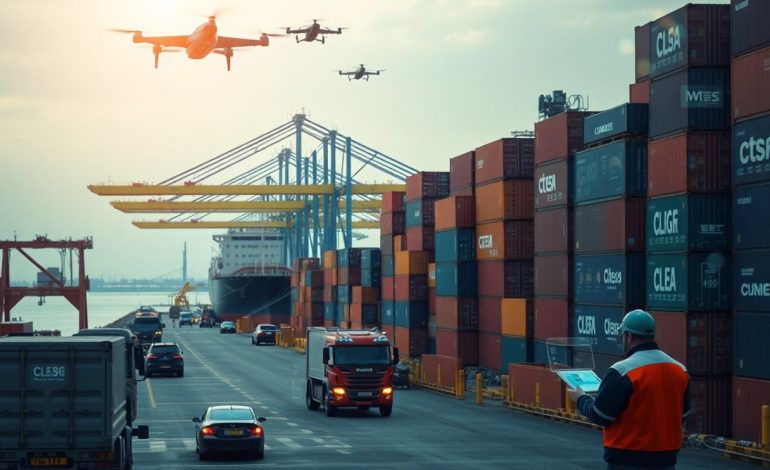
This guide explains how big data transforms port operations so you can optimize logistics, predict maintenance, and mitigate security risks using real-time analytics; by integrating sensor feeds and AI you gain operational efficiency, reduced downtime, and early threat detection, enabling your port to scale sustainably while safeguarding cargo and infrastructure.
Types of Big Data in Smart Ports
| Operational Data | AIS, VTS, TOS logs, crane telemetry, gate transactions; used for berth allocation, yard optimization and turnaround time reduction. AIS updates range from 2-10 seconds for moving vessels to minutes for stationary units. |
| Environmental Data | Weather stations, wave buoys, air quality (PM2.5, NOx, SOx), water quality and noise sensors; applied to safety windows, emissions compliance and dredging schedules. Samples commonly at 1 min-1 hr intervals. |
| Traffic & Logistics Data | Truck GPS, rail manifests, ETS/EDI feeds, booking systems; enables ETA prediction, gate throughput optimization and reduced truck queuing through dynamic slotting. |
| Asset & Maintenance Data | Vibration, temperature, oil analysis, PLC telemetry from cranes and conveyors; underpin predictive maintenance, extending MTBF and lowering unplanned failures. |
| Economic & Market Data | Freight rates, slot availability, commodity flows and customs data; used for capacity planning, dynamic pricing and demand forecasting at terminal level. |
- Operational Data
- Environmental Data
- Traffic & Logistics Data
- Asset & Maintenance Data
- Economic & Market Data
Operational Data
When you ingest streams from AIS, crane PLCs and gate RFID systems, your analytics can align vessel positioning with terminal capacity in near real time; AIS transmissions typically refresh every 2-10 seconds for moving ships, giving you the temporal resolution necessary to predict berth windows and optimize tug allocation. Integrating TOS event logs with yard camera analytics lets you measure container dwell times (commonly 24-72 hours depending on trade and port), detect bottlenecks, and set operational KPIs by hour or shift.
Applying time-series models and anomaly detection to telemetry-such as crane cycle counts and motor vibration-supports predictive maintenance and can cut unplanned downtime substantially in implemented projects. You can also fuse gate transaction volumes with truck GPS to produce short-term ETA forecasts that reduce gate queue length and idle emissions, while maintaining berth utilization at target levels.
Environmental Data
Sensors for wind, wave height, visibility and air pollutants feed operational decisioning: high waves above about 2-3 m typically force restrictions on mooring and cargo handling, while spikes in PM2.5 or NOx trigger mitigation like switching to shore power or limiting diesel-powered equipment. You should sample weather and air-quality data at high enough frequency (minutes to hourly) to enable automated alerts and to meet reporting windows for regulators and corporate sustainability programs.
Combining on-site monitors with forecast models and satellite feeds enables you to forecast environmental risk 24-48 hours ahead, schedule dredging within safe windows, and verify compliance with emission-control rules such as local ECA limits and IMO guidance. Real-time linkages between emissions sensors and vessel call records allow enforcement or targeted incentives; high pollutant readings are a dangerous trigger for public health alerts, while emission reductions achieved through operational changes are a positive outcome you can quantify.
Fusing meteorological forecasts, buoy data and AIS lets you build predictive models that estimate when air or sea conditions will breach thresholds and automatically recommend actions-ranging from ramping up shore power to delaying hazardous lifts-and gives you auditable evidence for regulators and port stakeholders. Assume that you integrate these streams into a unified analytics layer so automated mitigation workflows trigger as soon as thresholds are crossed.
Tips for Leveraging Big Data in Port Operations
Adopt a layered implementation that separates edge ingestion, short-term stream processing, and long-term archival so you can manage both volume and velocity without overloading central systems. Prioritize data governance and asset tagging from day one: consistent identifiers for cranes, containers, and berths cut integration time by weeks and make data analytics outputs actionable. Test sample rates – for positional telemetry use 1 Hz to 5 Hz for cranes and RTGs, 0.1 Hz for environmental sensors – and provision storage so that hot-tier data covers at least 30-90 days of detailed traces before aggregation.
- Instrument gates, cranes, and straddle carriers with synchronized timestamps (GNSS/UTC) to avoid reconciliation drift.
- Use message brokers like Kafka for buffer bursts and Flink or Spark for stream processing when you need sub-second decisioning.
- Apply role-based access and field-level masking to minimize exposure of PII and commercial secrets.
- Run pilot projects on a single terminal or berth to validate KPIs – throughput, dwell time, and crane utilization – before scaling.
Data Collection Strategies
Instrument the high-impact touchpoints first: gates, quay cranes, RTGs, AIS feeds, and yard sensors; these typically account for 70-80% of operational variance. Implement edge filtering to emit events only on state change or threshold crossings – for example, report container-handling events and exceptions rather than constant telemetry – which reduces bandwidth and storage cost while preserving the signals you need for predictive maintenance and scheduling.
Combine structured operational feeds (EDI, AIS, ERP logs) with unstructured sources (camera OCR, CCTV analytics) and label them with consistent metadata to support traceability. Maintain an ingestion schema registry and enforce compact binary formats (Avro/Parquet) for long-term storage to speed analytics and lower costs; aim to aggregate raw high-frequency data into hourly and daily rolled-up tables for historical modeling.
Data Analytics Tools
Deploy a hybrid architecture: run time-sensitive pipelines at the edge or in a nearby cloud region and use centralized clusters for model training and longer-term simulation. For real-time oversight, combine streaming analytics (Kafka + Flink) with a low-latency feature store so you can score models with millisecond to second latency for berth allocation and tug scheduling. For batch analytics and historical trends, use distributed compute like Spark and columnar storage to reduce query times on months of records.
Choose ML frameworks that match your use case: TensorFlow or PyTorch for deep learning on image-based crane analytics, and lighter XGBoost/LightGBM models for tabular forecasting where inference speed and explainability matter. Integrate observability (Prometheus, Grafana) and model-monitoring so you can detect concept drift – set alerts on degradation beyond a 5-10% drop in key metrics such as throughput prediction accuracy.
Optimize deployment with containerized microservices and CI/CD pipelines for models so you can push retrained predictors weekly or biweekly while preserving rollback points; enforce an SLA for critical pipelines (for example, 99.9% uptime for gate decisioning) and validate models on holdout windows that reflect seasonal peaks to avoid overfitting. Thou must enforce strict data-retention and access controls to limit operational and security risks.
Step-by-Step Guide to Implementing Big Data Solutions
Step-by-Step Guide to Implementing Big Data Solutions
Planning and AssessmentBegin by mapping your data landscape: list operational sources such as AIS, TOS/PCS logs, crane telemetry, gate OCR, CCTV video, and third-party weather and tidal feeds. Expect initial ingestion volumes in the order of 1-10 million AIS/telemetry messages per day and historical archives of 0.5-5 TB depending on retention; use those figures to size storage and compute. Define measurable KPIs up front – for example, target a 10-20% reduction in quay crane idle time or a 15% drop in average berth waiting time – and build a business-case spreadsheet that ties those KPIs to dollars-per-day savings, staffing impact, and capital avoidance. Perform a risk and governance assessment covering PII in crew manifests, commercial sensitivity in cargo manifests, and cyber-attack vectors on telemetry networks. You should prioritize a data catalog and role-based access controls before any analytics work begins; a lightweight policy such as RBAC + data encryption at rest and in transit will mitigate the most common threats. Run stakeholder workshops (operations, terminal operators, customs, IT) to score use cases by impact and feasibility, then select a 3-6 month pilot: pick one terminal or one process (e.g., berth allocation) and allocate a cross-functional team of 4-8 people. |
Execution and MonitoringStart the pilot by implementing a layered architecture: edge collectors (for low-latency sensor filtering), a message bus (Kafka or MQTT) for streaming, and a processing tier (Spark/Flint or real-time Flink) feeding a time-series store and OLAP cluster. Aim for operational latencies under 500 ms for critical ETA and berth-assignment updates and batch windows for historical analysis at night. Containerize models and services (Docker + Kubernetes) so you can push updates without terminal downtime; use canary deployments for production rollouts and quantify SLA targets (uptime >99.5%, mean time to recover <30 minutes). Implement monitoring across five pillars: infrastructure, data integrity, model performance, process KPIs, and security. Instrument data quality checks (schema drift, null rates, duplicate keys) and set alert thresholds tied to business impact – for example, if the percentage of missing crane telemetry exceeds 5%, escalate immediately. Complement dashboards (Grafana/Power BI) with automated anomaly detection for vehicle flows and container dwell times so that operations teams see both the raw metrics and suggested corrective actions. |
For monitoring and continuous improvement, establish a retraining and operations cadence: log model predictions and ground-truth outcomes, compute drift metrics weekly, and trigger retraining when error increases by >10% or after a fixed window such as every 7-14 days. You should also define runbooks that map specific alerts to on-call actions (who restarts a Kafka partition, who examines a stale AIS feed) and run quarterly post-mortems to convert outages into engineering or process changes; these practices reduce repeat incidents and secure the long-term value of your deployment.
Key Factors Influencing Smart Port Development
Several interlocking factors determine how effectively you can translate investments in big data into operational gains at your port. Governance and regulatory alignment set the rules for data sharing and privacy, while the physical and digital infrastructure determine latency, throughput and system resilience. Market dynamics – vessel schedules, peak-season surges, and hinterland capacity – create variability that your analytics must absorb; for example, many major hubs run on seasonal peaks where throughput swings by 10-30% month-to-month, demanding elastic processing and storage.
- Technology infrastructure – sensors, IoT, edge computing, private 5G, and cloud/data-lake architectures
- Data governance – metadata standards, access controls, and legal frameworks
- Stakeholder collaboration – terminal operators, carriers, customs, and rail/truck partners
- Workforce and skills – data engineers, analysts, and operations staff able to act on insights
- Financing and business models – CAPEX/OPEX mix, ROI timelines, and service-level agreements
Aligning these factors lets you move from pilots to scale: ports that combine a robust data governance model with interoperable APIs and shared KPIs typically reduce cargo dwell times and improve berth utilization. This alignment between governance, technology and cross‑party incentives ultimately determines whether your smart port delivers consistent, measurable value.
Technology Infrastructure
You must architect for both volume and velocity: port sensor networks, AIS feeds, CCTV and terminal operating systems can generate terabytes of telemetry daily, so you need a tiered architecture that places edge computing for sub-second control loops and a centralized data lake for historical modeling. Deploying a private 5G network or dedicated fiber can reduce latency from typical public LTE tens-to-hundreds of milliseconds down to the single-digit milliseconds needed for automated crane controls and real-time collision avoidance systems.
Standards and protocols matter: adopt MQTT, OPC-UA and RESTful APIs to integrate PLCs, RTGs and terminal operating systems, and ensure your AI models have labeled, time-synchronized inputs. Cybersecurity must be embedded-segmentation, encrypted telemetry and identity management prevent attacks that could halt operations or expose sensitive cargo manifests, and you should budget for ongoing patching and red-team exercises.
Stakeholder Collaboration
You need formal mechanisms to translate shared data into shared value: a Port Community System or neutral data-exchange platform helps synchronize arrivals, customs clearance and hinterland bookings so terminals and carriers can reduce idle time. In practice, when ports implement common message standards and SLAs, terminal throughput improves and disputes over data ownership decline; public-private partnership pilots often fund initial platform builds and then transition to user fees.
Governance frameworks should include explicit KPIs, dispute-resolution processes and phased data access levels so participants trust the exchange without exposing competitive information. For instance, shared visibility into truck appointment windows and berth allocation has reduced queuing at several major European ports, enabling smoother handoffs between maritime and land legs.
More operationally, you must design incentives and technical on-ramps: create sandbox environments for carriers to test APIs, publish anonymized datasets to accelerate third-party innovation, and negotiate cost-sharing for backbone services so all parties see a proportional return on their investment. This operational pragmatism-combined with clear legal agreements and training-drives adoption and sustained collaboration.
Pros and Cons of Big Data in Port Development
Pros and Cons Overview
| Pros | Cons |
|---|---|
| Improved operational efficiency and throughput | High initial capital expenditure for sensors, networking, and platforms |
| Real-time visibility across yard, berth and hinterland | Fragmented legacy systems and data integration challenges |
| Predictive maintenance reducing equipment downtime | Cybersecurity and ransomware exposure |
| Better environmental monitoring and emissions control | Privacy, regulatory and cross-border data-sharing constraints |
| Optimized resource allocation and reduced waiting times | Workforce displacement, retraining needs and change management |
| New revenue streams from data services and analytics | Vendor lock-in and proprietary data silos |
| Digital twins and simulation for planning and resilience | Ongoing costs for storage, model retraining and compute |
| Improved safety and faster incident response | Risk of false positives/automation overreliance |
| Stronger multi-stakeholder collaboration when data is shared | Governance gaps that undermine trust between stakeholders |
Advantages of Big Data Utilization
When you deploy big data platforms at scale, you can translate heterogeneous sensor feeds, AIS tracks and terminal operating system logs into actionable KPIs-operators commonly report measurable throughput and crane productivity gains, with many terminals seeing double-digit improvements in specific metrics after analytics-driven scheduling and yard optimization. For example, combining container flow prediction with berth-allocation models lets you reduce vessel turnaround and truck dwell time, which directly boosts port capacity without new berths.
You also gain predictive insights that convert maintenance from calendar-based to condition-based regimes: using vibration, temperature and usage telemetry you can lower unplanned equipment outages and extend asset life. In practice, terminals that integrate predictive-maintenance workflows with their TOS often reduce emergency crane downtime and spare-parts costs, while analytics-backed environmental monitoring helps comply with emissions limits and target electrification investments more efficiently.
Challenges and Risks
As you scale analytics, the most immediate hurdle is data quality and systems integration: port environments typically mix decades-old TOS installations, third-party carriers, OT devices and modern cloud APIs, creating messy schemas and latency spikes that break models. You must plan for robust ETL, canonical data models and ongoing data stewardship; otherwise predictive models will drift and deliver misleading recommendations.
Security is another major exposure: ports are critical national infrastructure and attractive targets for cyberattacks-Maersk’s 2017 NotPetya incident, which caused losses in the hundreds of millions of dollars, is a clear example of how malware can halt operations and cascade through supply chains. You need to treat cybersecurity, access control and incident response as core components of any big-data roll-out rather than add-ons.
To mitigate these risks you should adopt strong data governance-including role-based access, encryption at rest and in transit (e.g., TLS, AES-256), and compliance with standards like ISO 27001 or SOC 2-run phased pilots to validate ROI before full roll-out, and invest in workforce retraining programs so your people can interpret analytics and manage exceptions rather than being displaced by automation.
Summing up
From above you can see how Big Data consolidates vessel, cargo, sensor and market feeds to give you real-time visibility and predictive insights that optimize berth planning, yard management, equipment utilization and supply-chain coordination. These capabilities let you make data-driven decisions that reduce dwell times, improve throughput and enhance safety while aligning operations with regulatory and sustainability objectives.
By applying analytics and machine learning you move from reactive responses to proactive strategies, enabling predictive maintenance, demand forecasting and dynamic resource allocation that lower costs and increase resilience. To realize these benefits you must invest in interoperable platforms, strong data governance and skilled teams so your smart port initiatives deliver measurable ROI and scalable performance gains.