Digital Twin Technology and the Future of Ship Design

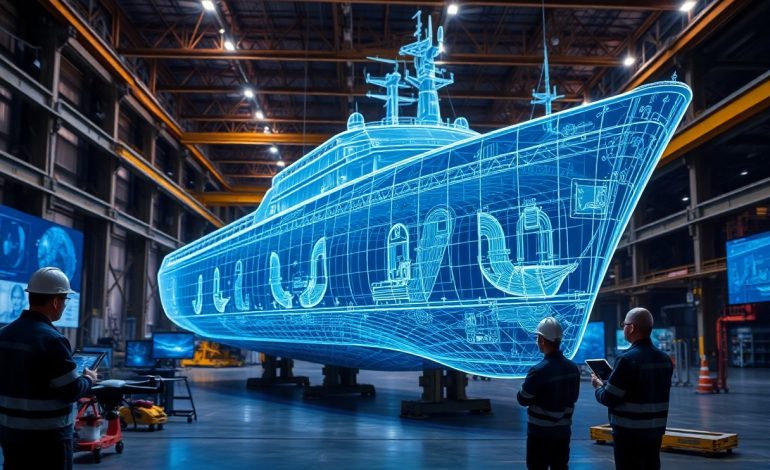
Many ship designers are turning to digital twins to give you a virtual mirror of a vessel that accelerates development and informs your decisions: by enabling faster, data-driven design iterations, providing early detection of critical failures that reduce operational risk, and delivering lower lifecycle costs and emissions through optimized maintenance and performance. This guide shows how to integrate models, sensors, and analytics so your fleet gains resilience, efficiency, and measurable ROI.
Understanding Digital Twin Technology
Definition and Overview
You interact with a digital twin as a dynamic virtual replica of a ship or its subsystems that ingests real-time data from sensors, combines that feed with physics-based simulation and machine learning models, and then mirrors behavior under operational conditions. Vendors and shipyards increasingly connect hundreds to thousands of sensors per vessel to track vibration, temperature, and fuel flow; this lets you run what-if scenarios before committing to hardware changes or route adjustments.
When you deploy a twin, you gain predictive insight-such as forecasting bearing wear or identifying hull fouling-so you can shift maintenance from calendar-based to condition-based, often producing measurable gains like fuel savings and lower downtime. At the same time you must mitigate cybersecurity risk and model drift, because inaccurate inputs or unsecured links can propagate errors across design and operations.
- digital twin
- real-time data
- simulation
- fuel savings
- cybersecurity
Types of Digital Twins in Ship Design
Component twins focus on single parts-an engine cylinder, propeller shaft, or heat exchanger-letting you monitor high-frequency signals (for example vibration spectra sampled at kHz rates) and run localized fatigue or wear models. System twins aggregate component models into subsystems such as propulsion or HVAC so you can optimize interactions and control logic rather than tuning parts in isolation.
Ship-level twins represent the entire vessel and enable route-level performance forecasting, trim optimization and integrated systems testing; fleet twins scale those capabilities to logistics, scheduling and emissions compliance across multiple hulls. Process twins model non-operational activities-shipyard assembly sequences or maintenance workflows-helping you reduce rework and compress delivery schedules by quantifiable margins.
In practical rollout you balance fidelity against compute cost: high-fidelity CFD or multiphysics models can take hours to run on HPC for a single design iteration, whereas reduced-order or data-driven twins produce near-real-time outputs suitable for onboard decision support. That trade-off determines whether you use a twin for detailed design validation, sea-trial reduction, or continuous operational support; integrating edge compute, cloud services and versioned model governance is how you manage that lifecycle and maintain trust in outputs.
- component twin
- system twin
- ship twin
- fleet twin
- process twin
| Component Twin | Vibration-based bearing health monitoring with predictive replacement timelines |
| System Twin | Propulsion system optimization combining engine maps and gearbox models |
| Ship Twin | Hull resistance and trim optimization for fuel-efficient routing |
| Fleet Twin | Voyage planning and emissions budgeting across a 50+ vessel fleet |
| Process Twin | Shipyard assembly sequencing and maintenance planning to reduce lead time |
Recognizing the distinctions between twin types lets you prioritize model fidelity, compute allocation and security controls so your investments produce measurable operational and design benefits.
Benefits of Digital Twin Technology
You gain measurable returns across the ship lifecycle by using digital twins to run virtual trials, predict failure modes, and optimize operations. For example, fleet operators report fuel savings of 3-7% after integrating hull-performance twins with voyage optimization; maintenance teams see reductions in unplanned downtime of 20-30% when predictive algorithms are fed with real-time sensor streams. At the design stage you can iterate hundreds of CFD and structural scenarios in parallel, which often shortens the concept-to-production window by 30-50% compared with traditional sequential prototyping.
Data-driven visibility also transforms decision making: you can compare lifecycle cost scenarios, validate retrofit impacts on emissions, and produce digital evidence for class approval and port authorities. When you combine model-based systems engineering with shipboard telemetry, the same virtual asset that informed design can be used for crew training, remote troubleshooting, and continuous regulatory compliance checks, delivering ongoing value well after the vessel leaves the yard.
Advantages for Ship Design
You can accelerate innovation by replacing single-run physical tests with multi-variable virtual experiments that reveal performance sensitivity to hull form, appendages, and propulsion choices. Running thousands of hydrodynamic cases or parametric structural analyses lets you find non‑intuitive trade-offs-one liner design team cut resistance by ~4% through iterative twin-driven hull tweaks that would have required multiple physical models. Integrating CFD, FEM, and systems simulations in a consistent digital environment also lowers risk when scaling up design changes to full production.
Early-stage adoption lets you validate alternative fuels, energy-storage layouts, and hybrid propulsion strategies before committing to hardware. For instance, simulating battery thermal behavior and power-management strategies across operational profiles can reduce battery oversizing by 10-15%, saving weight and cost. You also gain clearer certification paths: presenting simulation-backed performance envelopes to class societies reduces iterations during plan approval and shortens time to market.
Pros and Cons of Implementation
You should assess implementation across three axes: financial payback, technical readiness, and operational change. Many shipowners find a pilot on a single vessel delivers a clear ROI in 18-36 months, but that payoff depends on sensor density, data quality, and the maturity of analytics pipelines. Also note that cybersecurity gaps and fragmented vendor ecosystems represent the highest operational risks if you move too quickly without governance.
Pros and Cons of Implementation
| Pros | Cons |
|---|---|
| Reduced design cycle time (often 30-50%) | High upfront investment in tools, sensors, and training |
| Lower operational costs via predictive maintenance (20-30% less downtime) | Data integration complexity across legacy systems |
| Improved fuel efficiency (typically 3-7%) through iterative optimization | Increased attack surface and need for robust cybersecurity |
| Better regulatory and class documentation using simulation evidence | Dependence on sensor fidelity and model accuracy |
| Faster fault diagnosis and remote troubleshooting | Ongoing cloud, storage, and analytics costs |
| Enables crew training on virtualized ship behaviour | Organizational resistance and skill gaps |
| Lifecycle cost transparency for CAPEX/OPEX trade-offs | Potential vendor lock‑in or poor interoperability |
| Supports optimization for alternative fuels and emissions targets | Pilot scalability challenges from single-vessel proofs |
You will minimize downsides by starting with focused pilots that target high-impact systems (engines, hull performance, or electrical grids) and by establishing strong data governance up front; typical best practice is to instrument one or two vessels, validate models against measurements for 6-12 months, then scale. Additionally, investing in secure edge gateways and standardized APIs reduces integration and cybersecurity risks, while partnering with class societies or experienced integrators accelerates acceptance and shortens the ROI horizon.
Key Factors in Implementing Digital Twins
You must align your organizational priorities around data quality, lifecycle governance, and integration with existing ship systems. Sensor selection ranges from low-rate GPS and fuel flow at ~1 Hz to vibration and acoustic sensors sampling between 100-1,000 Hz, and misconfiguring sampling or retention policies will either drown your platform in noise or leave gaps that invalidate simulations. Regulatory interfaces with classification societies (ABS, DNV, Lloyd’s) and standards such as OPC UA and MQTT shape how you exchange telemetry and prove compliance; you should plan for at least one compliance audit per major rollout and expect pilot timelines of 6-12 months for a single-vessel proof of concept.
- Interoperability: mapping legacy NMEA/IEC 61162 outputs into a unified schema
- Edge computing: local preprocessing to cut bandwidth and latency
- Cybersecurity: network segmentation, PKI, and incident response playbooks
- Scalability: cloud-native microservices and container orchestration for multi-vessel fleets
- Simulation fidelity: CFD and FEM coupling frequency versus operational data cadence
Costs concentrate in integration and workforce change: pilot deployments commonly require a core team of 6-12 FTEs and an initial CAPEX of $100k-$500k per vessel for instrumentation and software, while documented pilots report operational fuel savings of 3-5% and maintenance reductions when you tie machine learning models to historical failure logs.
Technical Requirements
You need a layered architecture: sensors and PLCs feeding an edge gateway that performs fusion, filtering, and event detection before forwarding to cloud services via secure tunnels. In practice this means provisioning gateways with at least a quad-core CPU, 8-16 GB RAM, and local SSD cache (0.5-2 TB) for buffering during intermittent connectivity, plus telemetry pipelines that support both streaming (Kafka, MQTT) and batch ingestion for model retraining.
Latency targets differ by use case: for active control loops aim for sub-second RTT and local decision logic, while performance analytics and voyage optimization can tolerate minutes to hours. You should budget storage for high-frequency logs-tens to hundreds of GB per month per vessel depending on your sampling-and implement retention policies and compression; encryption at rest and in transit is non-negotiable to mitigate the most significant cybersecurity risks.
Team and Collaboration Considerations
You must assemble a cross-functional team combining naval architects, systems engineers, data scientists, IT/OT operators, and shipboard crew to avoid handoff failures. A pilot team of 8-12 people typically covers requirements, sensor integration, ML model training, and shore-crew liaison, and embedding one maritime systems engineer aboard during the first 60-90 days reduces rework by an estimated 30% in field trials.
Governance and decision rights should be explicit: define who approves model drift thresholds, who controls firmware updates to edge gateways, and how shipboard alarms map to operator workflows. Collaboration tools that bridge asynchronous (tickets, dashboards) and synchronous (ship-to-shore video, remote desktop) communication are necessary; expect an initial cultural friction cost as deck officers and data teams align on signal interpretation.
Any additional success factors include formal training programs for crew (6-12 hours per role) and a change-management cadence with monthly reviews during the first year.
Step-by-Step Guide to Utilizing Digital Twins
| Phase | Actions, deliverables & examples |
|---|---|
| Define objectives & scope | Set measurable KPIs (e.g., reduce unscheduled downtime by 15%, improve fuel efficiency by 5-10%). Limit initial scope to one system (propulsion or HVAC) and a single vessel for the pilot to reduce complexity. |
| Data strategy | Inventory sensors, telemetry rates, and historical logs. Plan for sampling rates from 1 Hz (slow temperature) to 100 Hz (vibration), estimate storage (1,000 sensors at 10 Hz ≈ ~7 GB/day raw), and define retention policies. |
| Model development | Choose model fidelity (reduced-order vs. CFD/FEM). Use physics-based models for structural/fatigue analysis and ML surrogates for anomaly detection. Tools: ANSYS Twin Builder, Siemens Simcenter, or custom Python stacks. |
| Validation & calibration | Calibrate against sea trials/historical failures. Target error bounds within 5-10% for performance metrics before deploying control or maintenance recommendations. |
| Deployment & integration | Implement edge gateways, secure APIs (OPC UA, MQTT, NMEA 2000 for navigation), and PLM/CMMS connectors (e.g., Maximo). Start with a 3-month pilot on a single vessel. |
| Operations & continuous improvement | Run A/B trials for maintenance strategies, feed outcomes back to models, and scale after achieving target ROI (typical industry pilots report 10-20% operational gains before fleetwide rollout). |
Initial Planning and Setup
You should begin by aligning stakeholders across design, operations, IT, and procurement, and by documenting the target use cases with specific KPIs (e.g., 15% downtime reduction, 7% fuel reduction). Allocate a realistic timeline: plan 3-6 months for a focused pilot that includes sensor verification, data pipeline setup, and an initial model build; larger, fleet-level programs typically extend to 12-18 months.
Your setup must include a clear data governance plan: define source systems, sampling rates, and quality checks, and estimate storage and compute needs up front. For example, ingesting 12 months of historical propulsion telemetry from 24 vessels may require multi-terabyte storage and batch-processing capacity; therefore provision edge filtering and cloud archival to control costs and latency. Ensure you sign vendor SLAs for model tools (Simcenter/ANSYS/3DEXPERIENCE) and assign a pilot owner who can commit ship-side resources for sea trials.
Integration with Existing Systems
Start integration by mapping interfaces and protocols: use OPC UA or MQTT for machinery telemetry, NMEA 2000 for navigation, and RESTful APIs for enterprise systems like PLM and CMMS. Implement an edge gateway to normalize streams, perform initial filtering/aggregation, and provide secure buffering so that intermittent connectivity does not compromise data continuity. In practice, you’ll often integrate with IBM Maximo or IFS for maintenance actions and with the ship’s automation bus via an OT gateway.
To deepen integration, follow a phased approach: 1) ingest historical logs (12-24 months) to train models, 2) pilot real-time feeds on non-critical systems for 3 months, 3) validate predictions against manual inspections, and 4) roll out closed-loop actions gradually. Be aware that improper segmentation or exposing OT directly to IT networks creates a high-risk attack surface; implement VLANs, VPNs, and data diodes where needed. Pilots that include a single vessel and one subsystem typically reveal integration mismatches within 4-8 weeks, enabling you to remediate before scaling.
Tips for Optimizing Ship Design with Digital Twins
You should prioritize modular model architecture so each subsystem – hull form, propulsion, HVAC, and cargo systems – can be updated independently; that lets you run targeted trade studies without re-simulating the whole vessel. In practice, teams reduce iteration time by 40-60% when they pair high-fidelity CFD runs with surrogate models for early-stage screening, and you should use the high-fidelity runs only for final validation.
- Digital twin governance: version models, tag data sources, and enforce an IMU for configuration control.
- Ship design modularity: separate hydrodynamics, structures, and systems models to speed parallel workstreams.
- Fuel efficiency targets: calibrate twins to real-voyage data to unlock the typical 10-15% savings reported by operators using continuous optimization.
When you integrate real-time sensor feeds, filter and timestamp rigorously to avoid model drift; mismatched clocks or unvalidated sensors create dangerous false positives in fatigue and stability alerts that can lead to costly rework. Apply continuous validation: compare predicted fuel burn and hull resistance to voyage measurements every 30-90 days and update empirical coefficients when deviations exceed 5%.
Best Practices for Use
You should define clear objectives for each twin instance – performance tuning, maintenance forecasting, regulatory compliance – and assign SLAs for data latency and model retraining so stakeholders know expected accuracy. For example, set an SLA of ≤15 minutes latency for propulsion control feedback loops and ≤24 hours for whole-ship performance analytics used in design trade-offs.
Adopt a hybrid simulation pipeline: run steady-state CFD and FEA for certification, use reduced-order models for parametric sweeps, and deploy digital thread links to live ship systems for continuous learning. You should also instrument critical zones with redundancy – two independent pressure sensors or IMUs – to increase confidence in anomaly detection and cut false-alert rates by an order of magnitude in tested fleets.
Common Pitfalls to Avoid
Relying on a single data source is a frequent error: GNSS-only speed and heading without speed-through-water or Doppler logs will skew resistance estimates and produce optimistic fuel forecasts. You should validate sensor suites against shore-based reference tests; an operator trial showed that adding a Doppler log corrected a 7% overestimate in predicted speed-related drag.
Overfitting models to historical operational profiles creates fragility when routes or loading conditions change – a twin trained solely on calm-weather voyages will underpredict risk in heavy seas. Use stress-case augmentation: simulate +/-30% load variations and at least three sea-state extremes so your models generalize and your design margins remain conservative rather than brittle.
You must watch for hidden costs in data management and licensing that can erode projected ROI, and enforce model transparency so engineers can trace decisions back to data and assumptions. Any failure to document assumptions or to validate against independent sea trials will undermine stakeholder trust and can produce design errors that are expensive to correct.
Future Trends in Ship Design and Digital Twins
Innovations on the Horizon
Expect digital twins to evolve from isolated simulation tools into federated, real-time ecosystems where onboard sensors, edge compute nodes, and cloud services run concurrent simulations; combining high-fidelity CFD, reduced-order models, and machine learning will let you test hull modifications in minutes rather than days. Shipyards and OEMs are already piloting this approach: hybrid twins that fuse physics-based models with ML were shown in trials to achieve fuel and emissions reductions in the range of 5-15% through continuous trim, propeller and shaftline optimization, and adaptive voyage planning.
Meanwhile, integration with lifecycle systems will deepen: you’ll link design models to manufacturing, certification and operations via a persistent digital thread, enabling model-driven commissioning and faster handovers. Standardization efforts by classification societies and industry consortia are accelerating, and you’ll see twins used to validate alternative-fuel conversions (ammonia, hydrogen, methanol) using transient engine and tank models so operators can demonstrate compliance with IMO and regional emissions rules before a single retrofit bolt is turned.
Impact on the Maritime Industry
Operationally, you can expect immediate gains in voyage efficiency and maintenance planning: operators using twin-led voyage optimization and condition-based monitoring report predictive maintenance can reduce unscheduled downtime by up to 30% and combined trim/route optimization yields tangible fuel savings. That translates to lower OPEX and higher asset availability, while shore-based operations centers consolidate insights across fleets so you manage dozens or hundreds of vessels from a single pane of glass.
For shipbuilders and suppliers, digital twins shorten production cycles and reduce rework by enabling precise prefabrication and virtual assembly checks; early adopters in Europe and Asia cite reductions in on-site adjustments and schedule slips. At the same time, you must contend with amplified risks: cybersecurity vulnerabilities, model drift from stale data, and unresolved data-ownership questions can erode trust in twin-driven decisions if not actively managed.
Regulatory and commercial ecosystems are also shifting: classification societies are publishing verification frameworks for twins, and some P&I clubs and marine insurers are piloting premium incentives for twin-monitored vessels-with early pilots indicating potential premium adjustments of roughly 5-10% where robust data governance and continuous monitoring reduce loss exposure; you’ll therefore need clear data-sharing agreements and audit trails to capture both operational value and insurance benefits.
To wrap up
Considering all points, you should treat digital twin technology as a transformative framework that enables you to simulate entire ship lifecycles, validate designs virtually, and anticipate operational issues before construction. By coupling high-fidelity virtual replicas with live operational data, you accelerate design iteration, reduce lifecycle costs, improve fuel efficiency and regulatory compliance, and support the transition to more autonomous and environmentally efficient vessels.
To realize these advantages, you must invest in interoperable data architectures, high-resolution sensors, and validated physics-based and data-driven models, alongside cross-disciplinary teams that bridge naval architecture, software engineering, and operations. With disciplined governance, robust cybersecurity, and standards adoption, your organization can scale digital twins from prototypes to fleet-wide platforms that continuously refine designs, extend asset life, and keep you competitive as shipbuilding evolves toward connected, sustainable futures.