Battery Hybrid Systems and Their Role in Green Shipping

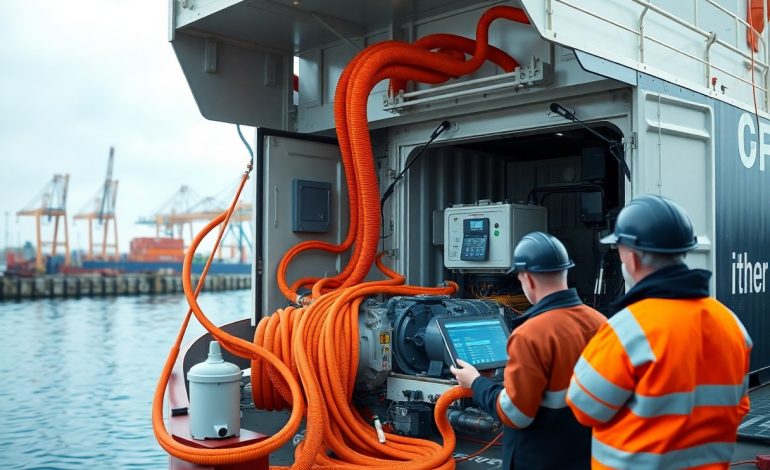
Shipping with battery-hybrid propulsion offers you a path to lower emissions and operational costs: substantial CO2 and NOx reductions and improved fuel flexibility, while integrating batteries to smooth load and enable port-side zero-emission operation. You must also manage fire and thermal runaway risks and lifecycle impacts through rigorous safety systems and maintenance. A well-designed hybrid system delivers reliable fuel savings and regulatory compliance, giving your fleet a pragmatic route to greener shipping.
Types of Battery Hybrid Systems
| Topology | Key points / Typical specs |
| Series Hybrid | Genset/ICE decoupled from propulsor; electric motor(s) drive propeller. Optimal genset loading, common for inland vessels; batteries typically 100 kWh-1 MWh for small ferries, up to several MWh for larger retrofit projects. Emissions reduction via duty-cycle optimization. |
| Parallel Hybrid | Engine and electric motor mechanically coupled (clutch/gear); both can provide propulsion. Good for peak-shaving and harbor zero-emission operation; battery power can cover short bursts up to 100% propulsion for minutes to an hour depending on pack size. |
| Power‑split / Combined | Combines series and parallel features with power electronics and gearboxes; enables flexible split of torque/power. Useful where both high continuous power and efficient cruising are required (RoPax, offshore supply). |
| Plug‑in / Battery‑dominant | Large battery pack used for primary propulsion with genset as range extender; allows scheduled zero-emission legs (harbor, route segments). Battery sizes often >1 MWh on modern ferries to achieve 20-60 minutes of all‑electric operation at service speeds. |
- Series Hybrid
- Parallel Hybrid
- Power‑split / Combined
- Plug‑in / Battery‑dominant
Series Hybrid Systems
You’ll find series hybrid architectures where the prime mover runs strictly as a generator, allowing the genset to be sized for average power and operated at its most efficient point; this often reduces specific fuel consumption by double-digit percentages versus a variable-speed genset under the same duty cycle. In practice, operators use this topology on inland vessels and workboats where duty cycles are cyclical – for example, a harbour-support vessel with a 400 kW average load might pair a 500-600 kW genset with a 300-500 kWh battery to smooth peaks and enable short all‑electric maneuvers.
You should be aware that the series layout simplifies mechanical design and can improve maintenance scheduling because the genset sees a steadier load, but it places higher demands on the electric drive and power electronics; therefore thermal management and inverter redundancy become important safety and reliability considerations for continuous operation.
Parallel Hybrid Systems
In a parallel hybrid, you can have the diesel engine and electric motor share torque through a gearbox or clutch, which makes the system inherently effective at peak-shaving: the engine handles continuous cruise while the battery supplies transient power for acceleration, maneuvering, or peak loads. Typical implementations in tugs and coastal ferries use battery packs from ~200 kWh to >1 MWh and can reduce fuel consumption during port operations by up to 30% depending on route and charging availability.
Your control strategy will determine how much time the vessel runs in all‑electric mode; some designs let the battery supply full propulsion for short harbor entries, while engines are re-engaged for open-water legs. Be mindful that mechanical integration adds complexity to clutch/gearbox control and increases the need for synchronized torque management to avoid driveline stress.
Additional operational benefit is regenerative energy capture during braking or propeller-driven motoring-if your vessel routinely decelerates or runs onshore-tethered loads, you can recover kilowatt-hours that would otherwise be wasted, improving overall system efficiency and reducing genset runtime.
After you evaluate your vessel’s duty cycle, shore‑power access, and safety constraints you can select the topology that best balances emissions, cost, and operational flexibility.
Factors Influencing Battery Hybrid System Selection
You’ll weigh system-level trade-offs such as battery capacity (from hundreds of kilowatt-hours to multiple megawatt-hours), peak power capability, weight and volume constraints, and total installed cost versus lifecycle cost. Specific examples help: small commuter ferries often deploy 0.5-2 MWh packs to run several short crossings on battery alone, while larger RoPax or cruise vessels typically use batteries in the single- to double-digit MWh range for peak shaving and hotel-load support rather than full-electric propulsion. Regulatory drivers and port-side shore charging availability also shift the balance-if you have scheduled 15-20 minute turnarounds and access to 2-4 MW chargers you can prioritize opportunity-charging architectures; if you operate long ocean legs, a genset-coupled hybrid remains more practical.
- Vessel size
- Operational patterns
- Battery capacity
- Power demand / C-rate
- Charging infrastructure
- Lifecycle cost & maintenance
Safety and chemistry choice (for instance, LFP for higher cycle life and lower thermal risk versus NMC for higher energy density) frequently determine whether the system is feasible from an operational and insurance standpoint. The selection will usually require vessel-specific mission modelling, grid and shore-side integration studies, and clear contingency planning in case of battery-related faults or thermal events. The
Vessel Size and Type
When you size systems to vessel class, match propulsion power and endurance: harbor tugs and workboats with propulsion ratings of a few hundred kW can often be fully battery-electric with packs in the 100-500 kWh range, while feeder container ships or large ferries with propulsion in the 3-15 MW band typically need multi-megawatt battery arrays (1-10+ MWh) for effective peak shaving. For context, the MF Ampere-type ferries deployed in Norway used roughly 1 MWh battery systems and 2-3 MW charging to operate as battery-first vessels on short routes, demonstrating that moderate-sized vessels can reach near-zero-emission operation in service.
As you scale up to RoPax and cruise, power demands and weight penalties grow quickly: propulsion and hotel loads can reach tens of megawatts and tens of MWh of stored energy to maintain endurance, so most large vessels adopt hybrid architectures where batteries provide peak-power support, redundancy and emissions reductions in port rather than full-electric propulsion. Fire and thermal runaway risks become increasingly significant with pack size, so larger installations require more sophisticated containment, monitoring and suppression systems and often influence insurer requirements and layout decisions.
Operational Patterns
Your daily duty cycle-number of voyages, transit duration, port dwell times and backup requirements-directly governs battery sizing and the preferred hybrid topology. Short-sea ferries running dozens of crossings per day typically need fast-charging capability and higher cycle life chemistry; example projects in Scandinavia use 2-4 MW shore chargers to recharge 1 MWh packs during 10-20 minute turnarounds. Conversely, ships with long overnight legs rely on batteries sized for limited peak shaving and hotel-load support, reducing required charge power but increasing onboard energy capacity.
Charging windows and grid constraints are pivotal: if shore power is limited or costly, you’ll favor larger onboard energy buffers to avoid frequent high-power charges, but that increases weight and cost. You also need to plan for grid upgrades-installing a 5 MW berth charger can trigger transformer and shore-side works costing hundreds of thousands to millions of dollars-so integrated economic and infrastructure assessments are part of selection. Operational reliability depends on conservative sizing and redundancy to prevent service interruptions.
More technically, you should model annual equivalent full cycles (EFC), depth-of-discharge profiles and expected C-rates: choosing LFP can give >4,000 cycles and better tolerance of high C-rate opportunity charging, while NMC offers higher energy density but typically 2,000-3,000 cycles and greater thermal management requirements; these parameters determine replacement intervals, warranty exposure and lifecycle cost, and they directly influence your maintenance and spare-capacity strategies.
Advantages of Battery Hybrid Systems in Shipping
When you evaluate the operational edge hybrid architectures deliver, the primary benefits fall into two buckets: emissions reduction and operational efficiency. Hybridization lets you shift high-load, intermittent demands onto battery banks and run diesel/genset assets closer to optimal load, which often reduces specific fuel consumption by 10-30% for short-sea and feeder operations and can be even higher during port manoeuvres. In practice that means fewer hours on the main engines, lower noise levels during berthing, and the ability to operate with near-zero local emissions in port environments where regulations and community pressure are strongest.
You also gain design and operational flexibility: batteries let you downsize gensets (typical genset capacity reductions of 20-50% are achievable depending on duty cycle), provide instantaneous power for peak shaving and dynamic positioning, and offer redundancy that improves reliability at sea. For retrofits this modularity shortens installation time and lets you scale capacity from a few hundred kilowatt-hours up to multiple megawatt-hours as route requirements evolve.
Environmental Benefits
By storing and deploying energy strategically, you can cut local emissions dramatically-hybrid ferries and workboats routinely show >90% reductions in NOx, SOx and particulate emissions during battery-powered segments, and measurable CO2 savings on many routes. For example, short passenger ferries that operate battery-assisted profiles can eliminate emissions in port and reduce lifecycle CO2 by 20-40% versus conventional diesel-only operation when charged from a low-carbon grid.
Operationally, you’ll avoid the heavy fuel consumption spikes associated with manoeuvring and peak loads; that both lowers pollutant output and reduces underwater radiated noise, which benefits marine life on sensitive coastal routes. However, the environmental upside depends on how you charge: grid carbon intensity and the source of shore power will determine whether your net lifecycle emissions fall as much as the onboard figures suggest.
Economic Incentives
You can recoup hybrid system costs through a mix of direct savings and external incentives: lower fuel consumption, reduced maintenance hours (engines running fewer hours typically cut scheduled maintenance and overhaul frequency by an estimated 20-40%), and port fee discounts for low-emission vessels all improve operating margins. Typical payback windows reported in industry studies range from 3 to 7 years, driven largely by your route intensity and local fuel vs. electricity prices.
Policy mechanisms accelerate that math-carbon pricing under schemes like the EU ETS, national grant programs (for instance Norway’s Enova historically subsidizes clean maritime projects), and green corridor funding can shave significant upfront CAPEX or operating costs. Ports such as Oslo and Rotterdam already provide lower berth charges or priority access for low-emission vessels, which directly improves your route economics when you can operate on battery power during port stays.
Financing and business-model innovation also matter for your decision: battery leasing or “battery-as-a-service” models remove large up-front costs and can make the total cost of ownership superior to diesel-only systems. Combine that with advanced energy-management software and optimized charging schedules-operators report additional fuel and electricity cost reductions of 5-15%-and the commercial case for hybridization strengthens further, especially on high-frequency short-sea and ferry routes.
Disadvantages and Challenges of Battery Hybrid Systems
Despite clear operational benefits, you will encounter several practical and economic hurdles when assessing battery-hybrid adoption. Project-level trade-offs often shift from technical optimization to finance, port-side infrastructure, and regulatory compliance; for example, the up-front capital and integration complexity can outweigh fuel savings for long-haul vessels or low-utilisation routes. In retrofit scenarios you should expect extended yard time, added downtime risk, and the need for specialist contractors – all of which can push a project timeline from months to over a year.
Operationally, some risks are non‑technical but still material: crew training, insurance premiums, and shore-power availability frequently determine whether a hybrid installation actually delivers the modeled benefits. Large operators in Norway and Northern Europe have shown good outcomes on short-sea routes, yet you’ll find the model breaks down for deep-sea trades unless battery prices, charging infrastructure, and regulatory incentives align.
Initial Investment Costs
Installed battery systems for vessels typically range from approximately $300 to $800 per kWh once you include cells, BMS, switchgear, converters and civil works; therefore a 2 MWh package can add roughly $0.6-1.6 million to CAPEX, while a 4-6 MWh solution for a RoPax or offshore vessel commonly pushes the bill into the $1.2-4.8 million band. You must also budget for system integration, structural modifications and certification – in practice those balance‑of‑plant and integration costs can be an extra 10-30% premium on top of the hardware cost, and retrofits are typically at the higher end of that range.
Payback windows vary widely: on short, high-frequency ferry routes you can see simple paybacks of 3-6 years when fuel costs are high and shore-charging is cheap; by contrast, for feeder containerships or low-utilisation vessels payback can extend to 8-12 years or longer, making third‑party financing, grants, or green leases crucial to make projects viable. Public incentives in markets like Norway, the EU and parts of North America routinely bridge a significant portion of the CAPEX gap, so you should factor available subsidies into your financial model early.
Technical Limitations
Battery energy density remains the single largest technical constraint: lithium‑ion cells deliver roughly 150-250 Wh/kg at pack level, whereas marine diesel fuel contains about ~12,000 Wh/kg (lower heating value). That orders‑of‑magnitude difference forces tradeoffs between range, payload and available space – for example, to match a few days of endurance you may need several hundred tonnes of battery, which directly reduces cargo or passenger capacity.
Thermal management, fire suppression and degradation are also persistent issues. Large battery rooms demand segregated compartments, active cooling and certified fire‑suppression systems because a single cell failure can propagate; classification societies such as DNV and Lloyd’s have published battery-installation rules you must follow. Expect pack capacity to decline with use: typical maritime duty cycles produce 3,000-8,000 cycles depending on depth‑of‑discharge and chemistry, and many operators plan for module replacement or repurposing after 5-10 years when capacity falls to around 80%.
Charging infrastructure and grid constraints compound these limits: short‑turnaround ferries often require 1-5 MW shore chargers to maintain schedules, and ports without adequate distribution upgrades cannot support fast replenishment. In practice you’ll need to coordinate with port authorities and utilities early; grid reinforcement projects can add hundreds of thousands to millions of dollars and take years to complete, effectively gating deployment timelines.
Tips for Implementing Battery Hybrid Systems
You should prioritize a staged deployment that starts with a feasibility study, moves to a pilot retrofit (typically a 200-500 kWh demonstrator for ferries or a 1-2 MWh pack for short-sea vessels), then scales to full installation; operators have reported fuel savings of 10-30% on many coastal routes when controls and shore charging are optimized. Evaluate the route profile, duty cycles, and peak load to size both the battery hybrid systems and the accompanying genset/inverter stack so you avoid oversizing energy capacity at the expense of system cost and weight.
- Match battery chemistry to duty: LFP for >3,000 cycle life and thermal stability; NMC when you need higher energy density.
- Specify a BMS with cell-level monitoring and active thermal management to mitigate thermal runaway risks.
- Plan shore-side charging infrastructure and harmonize with port power capacity and tariffs to maximize availability.
Integrate lifecycle cost analysis (capex + maintenance + replacement) and model payback against today’s bunker prices-many retrofit projects hit payback in 3-7 years depending on utilization. Train crew on emergency procedures and maintenance intervals, and ensure your implementation plan allocates time for FAT, sea trials, and class approval to avoid delays.
Choosing the Right Components
You should select batteries by balancing power (kW) and energy (kWh) needs: for peak shaving and propulsion assist prioritize high C-rate packs and robust inverters, while for extended zero-emission operation size larger energy banks (2-5 MWh for RoRo ferries). Specify cell chemistry with proven marine track records-LFP often provides 3,000-7,000 cycles and greater thermal stability, whereas NMC may give ~150-250 Wh/kg if space and weight are tightly constrained.
Include redundancy at the string and inverter level and demand a BMS that supports SOC balancing, predictive degradation models, and remote diagnostics; require thermal management capable of maintaining cell temperature within 15-35°C under full charge/discharge to extend life. Factor in warranty length (often 5-8 years or specified cycle counts), expected end-of-life capacity (typically 70-80%), and modules designed for easy replacement to reduce downtime.
Collaborating with Experts
You should engage classification societies early-DNV, Lloyd’s Register or ClassNK provide guidelines and will flag design elements that affect approval, such as ventilation, fire suppression, and containment. Work with experienced system integrators and naval architects who can run coupled simulations (electrical load flow, thermal, and vessel stability) and validate control strategies against measured duty cycles to avoid undersized cooling or overstressed inverters.
Adopt a vendor-neutral procurement phase to compare proposals on lifecycle performance, not just capex: request measured data from pilots (cycle aging curves, efficiency at different depths-of-discharge) and require FAT and SAT with third-party witnessing. Include port authorities and shore-power providers early so you secure required power upgrades and negotiate tariffs that support rapid peak charging without excessive demand charges.
Knowing which stakeholders to involve-battery OEMs, system integrators, class societies, port operators and your operations team-and mapping responsibilities for testing, commissioning, and crew training will accelerate approval and reduce operational risk.
Step-by-Step Guide to Integrating Battery Hybrid Technology
Integration Steps Overview
| Step | Key actions / considerations |
|---|---|
| Assessment & Planning | Mission profile, energy demand modelling, class society engagement, space/weight/stability review, CAPEX/OPEX analysis |
| Design & Engineering | System architecture, BMS/PCS selection, cooling, fire protection, structural reinforcement, control integration |
| Procurement | Specify battery chemistry and capacity (100 kWh-several MWh), order long-lead items, arrange manufacturer FAT |
| Installation & Testing | Onboard fit-out, HV cabling, earthing, BMS commissioning, FAT/SAT, sea trials, performance validation |
| Commissioning & Operations | Crew training, maintenance plan, remote monitoring setup, KPI tracking (fuel, emissions, availability) |
Assessment and Planning
You should begin with detailed duty-cycle analysis using at least one year of operational data to size the system: short-sea ferries often need hundreds of kWh to several MWh, while harbor tugs can be served by 100-500 kWh packs. Conduct energy modelling that includes peak power events, regenerative capture on deceleration, and shore-charge windows; this typically reveals whether a pure-electric, hybrid, or range-extender topology is most cost-effective.
Engage class societies (DNV, ABS, Lloyd’s) and flag state early so your design matches certification pathways and safety cases. Factor in structural modifications, added mass and center-of-gravity shifts, and estimate retrofit timelines-most retrofit projects fall in the 3-9 month range-and run a financial sensitivity showing payback across fuel prices, e.g., payback can be under 5 years for high-utilization ferries with frequent port charging.
Installation and Testing
During installation you will need coordinated teams for structural works, electrical integration, and safety systems; route HV cables for minimal exposure and install segregated compartments with dedicated ventilation and fire suppression. Expect system voltages up to 1,000 VDC, so isolate circuits and verify protective devices before energizing. Factory Acceptance Tests (FAT) should precede begination, with the Battery Management System (BMS) and Power Conversion System (PCS) validated against simulated loads.
Onboard commissioning requires staged energization: verify insulation resistance, perform low-voltage control checks, then dry-run power transfers before full-load trials. Conduct Sea Acceptance Trials (SAT) focused on charge/discharge cycles, transition between battery and genset modes, and regenerative events; metric targets should include average fuel reduction and system availability. Operationally, hybrid retrofits have delivered 15-30% fuel savings on many short-sea routes-confirm similar gains via onboard energy logging.
For testing rigor, implement a documented test matrix that covers functional safety, contingency scenarios (BMS fault, bus failure), and thermal runaway mitigation drills; record telemetry at 1 Hz or better during sea trials to capture transient behavior. You must also train crew on emergency isolation procedures and maintenance checkpoints so your system remains safe and delivers the projected emissions and cost benefits.
Conclusion
Taking this into account, you can recognize that battery hybrid systems deliver measurable reductions in greenhouse gas and local pollutant emissions while improving fuel efficiency and operational flexibility for your vessels. By enabling peak-shaving, silent maneuvers in port, and integration with shore power or onboard renewables, these systems let you optimize voyage profiles, lower operating costs, and meet tightening regulatory standards without a full immediate transition to alternative fuels.
As energy density, charging infrastructure, and battery management advance, you will be able to scale deployments across newbuilds and retrofits, refine your total cost of ownership models, and leverage incentives to accelerate adoption. To realize those gains you should align technical assessments, crew training, and maintenance planning with lifecycle considerations so your fleet captures both environmental and commercial benefits over the long term.