Smart Port Innovations Enhancing Global Trade Efficiency

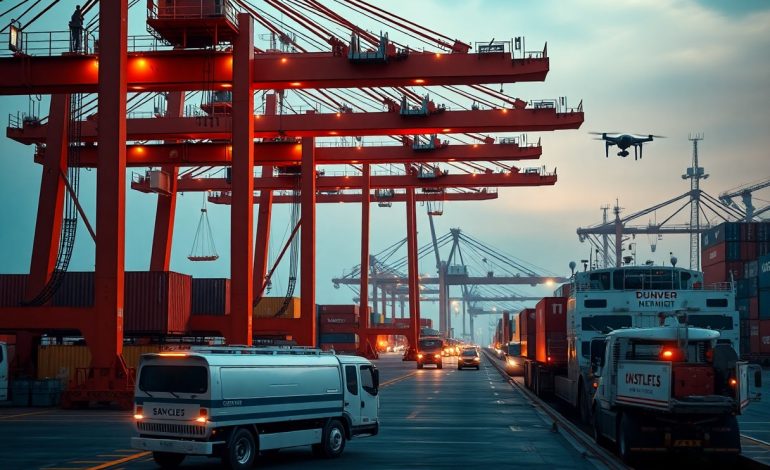
You rely on smart port technologies to streamline cargo handling, automate workflows, and speed transit, giving your supply chain higher throughput and lower costs, while advanced sensors and AI improve safety and routing; be aware that interconnected systems introduce heightened cyber and operational risk, so you must balance adoption with robust security and contingency planning to fully capture the trade-enabling gains.
Types of Smart Port Innovations
| Automation Technologies | Automated stacking cranes, AGVs, and remote-operated quay cranes deployed at terminals such as Maasvlakte II (Rotterdam) and PSA Pasir Panjang (Singapore). |
| IoT Integration | Wide sensor networks (RFID, vibration, temperature), asset trackers and 5G/LPWAN connectivity enabling predictive maintenance and real-time yard visibility. |
| AI & Data Analytics | Predictive berth allocation, demand forecasting, and anomaly detection using machine learning and digital twin simulations to optimize throughput. |
| Digital Twin | High-fidelity port models that simulate flows, test scheduling scenarios, and validate infrastructure changes before physical deployment. |
| Cybersecurity & Edge Computing | On-site edge processing to reduce latency and segmented defenses to mitigate cyber threats that could halt operations. |
- Throughput gains via automation and optimized scheduling.
- Visibility improvements from IoT tracking and sensor fusion.
- Predictive maintenance lowering unscheduled downtime.
- Risk exposure to cyberattacks requiring hardened controls.
- Sustainability benefits from electrification and route optimization.
Automation Technologies
You encounter full-terminal automation in modern hubs where remote-operated quay cranes and yard robots coordinate through centralized control systems; for example, APM Terminals Maasvlakte II uses automated ship-to-shore cranes that integrate with terminal operating systems to speed handling of mega-ships. Operators often deploy fleets of AGVs that run 24/7 and reduce manual transfers, while automated gate systems cut truck turnaround times and congestion at peak periods.
When you evaluate automation, factor in integration costs and workforce transition programs: retrofitting legacy yards requires both physical investments and retraining programs for technicians and supervisors. Vendors typically report faster berth service times and higher reliability, but you must also plan for redundancy and maintenance schedules to avoid single points of failure.
IoT Integration
You see IoT rollouts combining thousands of endpoints-RFID readers, temperature and vibration sensors, and GPS trackers-feeding telemetry into cloud and edge platforms; ports such as Hamburg and Valencia have trialed 5G and LPWAN networks to support low-latency control and long-life battery sensors. The immediate payoff is in condition-based maintenance: sensors flag bearing wear or hydraulic leaks days before failure, so you avoid extended crane outages.
More granularly, you can aggregate IoT feeds to create heatmaps of yard congestion and to automate gate appointment enforcement, improving truck dwell times and reducing idling emissions; industry pilots report measurable reductions in dwell and faster customs processing when IoT data is shared with terminal operators and carriers.
Additional implementation detail: you should architect IoT with edge preprocessing to filter raw telemetry, deploy standardized message formats like MQTT or AMQP for interoperability, and enforce device identity and firmware update policies to limit the cybersecurity attack surface while maintaining high data fidelity for analytics.
AI and Data Analytics
AI systems help you forecast demand spikes, allocate berths dynamically, and sequence quay tasks to minimize crane idle time; digital twins coupled with ML let you simulate what-if scenarios-such as rerouting containers during terminal blockages-before committing assets. Ports leveraging these capabilities, like Rotterdam’s digital initiatives, combine historical AIS and terminal event data to reduce decision latency and better match labor and equipment to expected flows.
At the operational level, anomaly detection models identify atypical container movements or customs discrepancies that could indicate fraud or loss, and prescriptive analytics suggest recovery actions. When you integrate AI into the control loop, ensure models are explainable to operators and validated against seasonality, special cargo types, and extreme-weather events to avoid brittle recommendations.
More information: you should maintain continuous model retraining pipelines using labeled events (delays, equipment faults) and A/B test scheduling policies in the digital twin; this approach reduced simulated dwell times in several pilot programs and allows you to quantify ROI before wide rollout while highlighting potential failure modes that require human oversight.
Perceiving the trade-offs between throughput gains, capital expenditure, and operational risk will let you prioritize which smart port innovations to adopt first.
Tips for Implementing Smart Port Solutions
To move from pilot projects to steady-state operations, you should adopt a phased, metrics-driven rollout that pairs technology adoption with operational change management. Start with small, contained pilots-preferably focused on a single berth, yard block, or gate lane-so you can measure impacts like throughput, container dwell time, and equipment utilization; many ports scale successful pilots across terminals within a 6-18 month window. Combine on-premise edge computing with cloud analytics to keep latency-sensitive controls local while aggregating historical data for machine learning models, and ensure your network architecture supports IoT telemetry at scale.
Use KPIs tied to commercial outcomes (e.g., average truck turnaround, vessel berth productivity, and system uptime) and assign clear ownership for each metric. You should budget for both CapEx and OpEx-typical total cost of ownership analyses at major terminals show that upfront investment in automation and digital platforms is offset by 10-30% lower operating costs over 3-5 years when combined with process redesign. Pilot outcomes should feed into procurement specs, SDS for vendors, and contractual Service Level Agreements that protect your operational resilience.
- Assess critical paths (gate, yard, quay) and prioritize short-cycle wins.
- Standardize data models and message formats (e.g., adherence to international port community message standards).
- Secure OT/IT boundaries with IEC 62443-aligned controls and segmented networks.
- Measure with commercial KPIs and operational SLAs before scaling.
- Finance through phased capex, vendor performance guarantees, or public-private partnerships.
Assessing Needs and Infrastructure
Conduct a gap analysis that maps current assets, network topology, and power resiliency against your target architecture for smart port capabilities; include detailed inventories of cranes, RTGs, AGVs, gates, sensors, and legacy TOS integrations. You should perform network capacity planning early-aim for redundant fiber backbones, 10 Gbps aggregation between key sites, and sub-50 ms round-trip latency for control-plane communications where remote or semi-autonomous handling is involved. Include N+1 power design for critical control infrastructure and plan for battery or generator failover to avoid single points of failure.
Run load and failure-mode tests before full deployment: simulate peak-season throughput and device churn to validate how your digital twin or simulation environment predicts congestion and resource contention. In parallel, audit your data quality and tagging conventions so that telemetry from sensors and IoT devices feeds reliably into analytics pipelines; poor metadata or inconsistent timestamps can invalidate machine learning models and produce misleading operational recommendations.
Stakeholder Engagement Strategies
Map stakeholders across port authority, terminal operators, shipping lines, trucking companies, labor unions, customs, and hinterland rail operators, and create a governance forum with representation and voting rules to resolve tradeoffs. You should establish a steering committee that meets monthly during rollouts and defines KPIs, governance of shared data, and dispute resolution procedures; for example, set an initial uptime target of 95% for new control systems and a 30-90 day stabilization period tied to vendor remedies.
Negotiate data-sharing agreements up front that specify datasets, anonymization standards, retention windows (commonly 12-24 months for operational logs), and permitted uses so your blockchain or shared ledgers can provide provenance without exposing commercial secrets. Include training plans and change-management milestones for frontline staff-use blended learning (simulators, hands-on labs, and on-the-job coaching) and measure competence with practical assessments before expanding autonomous operations.
Drive alignment through targeted incentives: co-fund pilot costs with terminal operators, offer revenue-based sharing for efficiency gains, or provide congestion credits to trucking companies that adopt appointment systems. You might pilot a data marketplace where anonymized throughput datasets are exchanged under SLAs, and use that marketplace to demonstrate concrete benefits-such as a 15% reduction in peak gate queuing during a 3-month field trial-before committing to full-scale integration.
Recognizing that robust cybersecurity, clear data governance, and measurable commercial KPIs are the linchpins of successful smart port deployments will ensure your implementation delivers both operational resilience and trade efficiency.
Step-by-Step Guide to Upgrading Port Facilities
Upgrade Steps Overview
| Step | Key actions |
| Assessment & Planning | Capacity analysis, traffic forecasts, stakeholder workshop, financial model, risk register |
| Design & Procurement | Master plan, systems architecture (TOS, AIS, VTS), standards-based APIs, RFP & vendor selection |
| Pilot & Testing | Small-scale pilots (1 berth or yard block), integration tests, cybersecurity audits, KPI baseline |
| Scale & Roll-out | Phased rollout by terminal/berth, workforce training, contingency operations, external comms |
| Monitoring & Continuous Improvement | Real-time dashboards, digital twin validation, SLA enforcement, periodic reviews |
Planning and Design
You should begin with a rigorous demand forecast and scenario modelling that ties upgrades to specific outcomes – for example, sizing yard expansion to accommodate a projected 20-30% throughput increase over five years or planning quay length for vessels up to 400 m. Use a digital twin or simulation to test berth allocations, truck flows and crane profiles; Port of Rotterdam’s Maasvlakte 2 expansion used simulation-based design to justify roughly 7 million TEU of added capacity and avoid costly rework.
After scenario work, define an interoperable systems architecture: a TOS linked to a port community system and vessel traffic system via standardized APIs (IAPH/IMO-aligned where possible). Insist on modular hardware footprints and open protocols to prevent vendor lock‑in, and budget explicitly for cybersecurity, OT/IT convergence, and workforce retraining in the initial cost estimate.
Implementation Phases
Phase your rollout into pilot, scale and full deployment with clear go/no‑go gates; a realistic program will span 3-7 years depending on scale. Start with a pilot berth or yard block to validate AGVs, automated cranes or remote crane ops, then expand in 6-12 month increments while tracking KPIs such as moves per hour, average truck turnaround and container dwell time.
During procurement, split contracts into discrete scopes (civil, cranes, automation, software) to simplify change control, and require staged acceptance tests: factory acceptance, site acceptance, and operational acceptance. Protect operations with fallback modes and ensure your SLAs include penalties and performance bonus clauses tied to throughput and reliability.
For more precision, prepare a deployment checklist that includes: baseline KPIs, integration test scripts, rollback procedures, staff certification milestones, and a contingency fund of 10-15% of capex to cover unforeseen integration costs and schedule slippage.
Monitoring and Evaluation
Implement a real-time monitoring stack that feeds a unified dashboard combining AIS, TOS, gate systems and energy meters; target dashboards to show berth productivity (moves/hour), truck turn (minutes), yard utilization (%) and emissions (CO2-equivalent). Use the digital twin to run what-if analyses weekly and validate that software updates don’t degrade throughput – in one case study, weekly simulation checks prevented a 12% projected increase in dwell time after a software update.
Establish quarterly performance reviews with stakeholders and link payment milestones to measured outcomes. Include regular cybersecurity penetration testing and operational audits; a single integration flaw can cause significant operational disruption, so flag any high-severity vulnerabilities and remediate within defined SLAs.
For deeper evaluation, deploy predictive maintenance on quay cranes and yard equipment using vibration and oil analysis sensors to shift from reactive fixes to scheduled interventions, aiming to reduce unscheduled downtime by at least 30% within the first 18 months of sensor-driven maintenance programs.
Factors to Consider for Smart Port Development
You should evaluate physical and digital readiness in parallel: port layout, berth depth, electrification capacity, and back-of-port road/rail connectivity; along with IoT sensor networks, resilient cybersecurity architectures, and vendor interoperability standards. Real-world rollouts show that integrating a digital twin and automation platforms often yields throughput improvements of 10-30%, but requires upgrades to power infrastructure (transformer capacity, medium-voltage feeders) and predictable fiber/5G coverage to avoid costly delays during scaling.
Prioritize workforce transition plans, financing pathways, and environmental compliance up front. You can leverage models such as public-private partnership concessions, EU/ADB grants, or green bonds to spread the up-front cost; typical automated terminal projects range from hundreds of millions to over a billion dollars depending on land and equipment scope.
- Smart port architecture and interoperability standards
- Sustainability and emissions control (shore power, low-carbon fuels)
- Regulatory compliance and customs integration
- Economic viability and financing models
- Workforce reskilling and safety management
Recognizing the need to sequence investments so that technical, regulatory, and financial tracks converge before wide deployment.
Regulatory Compliance
You must align deployments with international and local maritime rules: ISPS for security, IMO regulations for emissions and ballast water, and customs single-window mandates for electronic cargo clearance. Many jurisdictions now require sandbox approvals for trials of autonomous vehicles and remote cranes, so plan pilot timelines to include regulatory engagement; for example, sandbox permits in Singapore and Norway shortened trial cycles by allowing conditional operations under monitored conditions.
Data governance is equally important: if you process personal or commercially sensitive data within the EU or transiting EU ports, GDPR compliance will affect your cloud and edge strategies, consent models, and retention policies. You should formalize SLAs with data processors, apply encryption-at-rest and in-transit, and map where data crosses borders to avoid fines and operational interruptions.
Environmental Impact
Adopt emissions-reduction measures that produce measurable gains: shore power (cold ironing) can cut vessel auxiliary-engine emissions at berth by up to 90% and electrifying cranes and yard trucks eliminates local diesel particulates. You ought to quantify baseline air and water quality, then model reductions from electrification, on-site renewables, and alternative fuels (battery or hydrogen-powered equipment) to qualify for green financing and lower operating fees tied to emissions performance.
Dredging, land reclamation, and lighting changes can harm local habitats and fisheries; you should implement environmental monitoring (real-time turbidity, noise, and biodiversity sensors) and mitigation plans such as phased dredging windows and artificial reef offsets. Case studies show ports that combined monitoring with community engagement saw permitting timelines reduced by months and stakeholder resistance decline measurably.
More information: to capture long-term value, embed sustainability metrics into KPIs-tons CO2e per TEU, shoreline NOx reductions, and percentage of on-site renewables-and link them to tariffs or incentives so operators and terminal handlers share the upside of lower emissions.
Economic Viability
Assess total cost of ownership, not just capital expenditure: include integration, cybersecurity, change management, and maintenance. Automation and digital twin projects often have payback horizons of 5-10 years under optimistic throughput growth assumptions, but sensitivity analyses should test lower cargo growth and higher labor-redeployment costs to avoid over-optimistic ROI estimates.
You should pursue blended financing: combine concessional loans, operator equity, and performance-based tariffs to make projects bankable while aligning incentives. For example, a concession model that ties fees to berth productivity and emissions intensity can attract private operators while protecting public interests.
More information: run scenario modeling with conservative volume forecasts (±10-20%) and include transition costs such as retraining, temporary productivity losses, and redundancy payouts so you can present lenders and stakeholders with realistic break-even and stress-test outcomes.
Pros and Cons of Smart Port Technologies
You will need to weigh measurable gains against operational and strategic trade-offs when assessing smart port rollouts; many terminals report clear ROI but also face persistent integration, security, and workforce impacts. Use KPIs such as TEU throughput, vessel turnaround, and dwell time to quantify benefits and compare them directly with upfront capital and ongoing digital risk exposure.
Below is a concise breakdown that helps you map individual technologies to likely outcomes so you can prioritize investments that align with your throughput targets, budget cycles, and regulatory environment.
Pros and Cons at a Glance
| Pros | Cons |
|---|---|
| Higher throughput and capacity utilization (automated yards increase moves per hour) | High upfront capital – automation and digital platforms can require tens to hundreds of millions of dollars |
| Reduced dwell time and faster vessel turnaround (projects report 20-40% reductions) | Integration complexity with legacy systems and multi-vendor stacks |
| Lower operating costs per TEU through automation and predictive maintenance (15-30% cost reductions reported in studies) | Cybersecurity exposure – malware or ransomware can halt operations and cause multi-million-dollar losses |
| Improved visibility and real-time decision-making via IoT and digital twins | Data governance and interoperability challenges across stakeholders and standards |
| Enhanced safety-fewer on-dock accidents with remote operations and sensor-driven alerts | Workforce displacement risk and a substantial reskilling requirement |
| Lower emissions per move through optimized routing and electrification | Dependence on reliable connectivity and power; outages degrade performance |
| Predictive maintenance reduces unplanned downtime and extends asset life | Vendor lock-in risk when proprietary platforms create switching costs |
| Better compliance reporting and audit trails with digitized documentation | Regulatory fragmentation across ports/countries slows rollouts and scale |
| Scalability for peak periods via automated gates and dynamic berth planning | Long payback periods for smaller terminals with low volume |
| Enables new service models (e.g., slot-booking marketplaces, dynamic pricing) | Requires continuous investment in software updates and cybersecurity |
Advantages of Enhanced Efficiency
You see direct operational gains when you implement integrated automation and digital platforms: automated stacking cranes and AGVs combined with terminal operating systems reduce manual touchpoints and boost crane productivity by double-digit percentages in many deployments. For example, yard automation at major terminals has been associated with truck turnaround improvements of around 30%, and the new Tuas Mega Port is designed to handle up to 65 million TEU on the premise that automation and digital orchestration will maintain throughput at scale.
When you centralize data streams into a single operating picture, your planners can shave hours off berth allocation and chassis repositioning decisions, cutting demurrage and idle time. That translates into measurable commercial benefits: lower per-TEU handling costs, improved schedule reliability for carriers, and the ability to serve larger vessels without proportional increases in labor.
Challenges and Limitations
You will encounter significant barriers during design and deployment: upfront CapEx for full-scale automation often reaches tens to hundreds of millions depending on terminal size, and fragmented legacy IT stacks make integration costly and time-consuming. Additionally, cybersecurity is not hypothetical-A.P. Moller-Maersk’s 2017 NotPetya incident caused widespread operational disruption and losses estimated at roughly $200-300 million, illustrating how a single breach can cascade across global logistics chains.
Operationally, you must manage workforce transitions carefully; automation can reduce headcount by significant percentages in certain roles, requiring substantial reskilling programs and social planning. Regulatory differences between jurisdictions also slow interoperability: inconsistent data standards force bespoke integration work that delays benefits realization and increases total cost of ownership.
More detail on these constraints shows why you should build resiliency and governance into projects from day one: implement segmented networks and offline fail-safes to limit attack surfaces, adopt open data standards or modular APIs to reduce vendor lock-in, and structure financing through public-private partnerships to spread CapEx risks while including explicit funding for training and transition programs so your operational continuity and community commitments remain intact.
Conclusion
The integration of real-time data, automation, and interoperable systems empowers you to optimize port operations, shorten vessel turnaround, and increase supply chain visibility; by leveraging AI-driven analytics, IoT sensors, and automated handling and gate systems, you can predict maintenance needs, allocate berths dynamically, and reduce idle time while meeting regulatory and environmental requirements.
The adoption of common standards, robust cybersecurity, and targeted workforce upskilling enables you to scale smart solutions securely and responsively; as you implement these technologies, your trade flows become faster, more transparent, and more sustainable, strengthening your operational resilience and competitive position in global markets.