Integrating Renewable Energy Systems Into Vessel Power Solutions

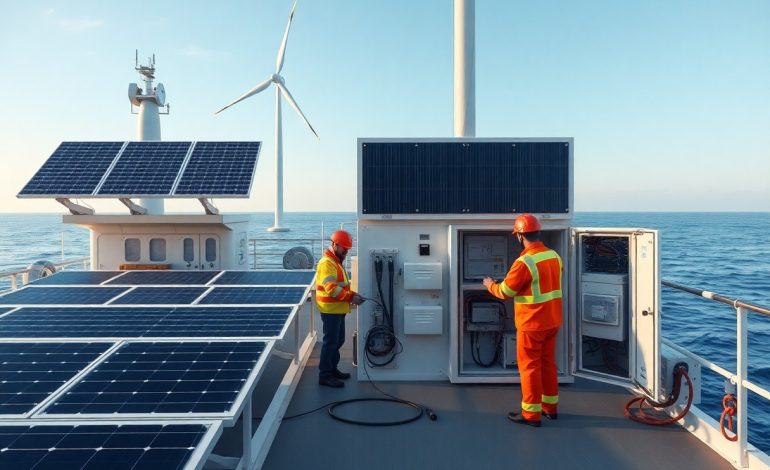
Energy integration on vessels demands rigorous system design so you can balance intermittent generation, storage capacity, and power conversion to protect system reliability, avoid electrical hazards, and seize fuel savings and emission reductions while meeting operational profiles and regulatory compliance.
Types of Renewable Energy Systems
| Solar PV | Deck- or superstructure-mounted arrays (monocrystalline, flexible), typical marine module efficiency 18-22% and specific yields ~100-200 W/m² depending on latitude and tilt. |
| Wind Turbines | Small HAWT/VAWT units rated 1-50 kW for auxiliary power; cut-in speeds ~3-4 m/s, rated output near 10-12 m/s; outputs scale with the cube of wind speed, so siting matters. |
| Biomass | Options include biofuels (HVO, biodiesel) for engines, onboard waste-to-energy (anaerobic digestion, gasification) for hotel loads; logistics and storage impact feasibility. |
| Hybrid Systems | Combining renewables with battery storage and gensets, energy management systems can reduce fuel consumption by 20-60% on auxiliary loads in documented retrofit projects. |
| Energy Storage | Marine-grade lithium-ion, LFP and flow batteries with capacities from 10 kWh to several MWh; design must address thermal management, BMS, and safety protocols for sea conditions. |
- Solar: predictable daily generation patterns, low moving parts, sensitive to shading and soiling.
- Wind: high instantaneous power potential, variable directionality and structural loading.
- Biomass: fuel-flexible but requires supply chain and emissions controls.
- Hybrid: maximizes uptime and reduces genset cycling when integrated with smart EMS.
- Storage: smooths renewables output, offers peak shaving and black-start capability.
Solar Power Integration
You can integrate solar PV by targeting high-insolation surfaces-house tops, containerized modules on deck, or flexible panels on awnings-where a 50-100 kW installation typically supplies 5-20% of hotel and auxiliary demand on medium-sized vessels depending on route and tilt. Panels with marine-grade coatings and stainless or anodized mounts resist salt corrosion; choose panels with an IP67 junction box and an IEC 61701 salt-fog rating when operating in heavy spray environments.
Mounting systems must account for dynamic load, so you should specify fasteners with backing plates and vibration-isolating pads, and route DC runs to central MPPT inverters minimizing conductor length to reduce losses. In retrofit cases, pairing PV with a battery bank and an energy management system reduced daily genset runtime by 4-8 hours on passenger ferries in several European projects, cutting fuel use for hotel loads by roughly 10-15%.
Wind Power Integration
If you add wind turbines, prioritize low-profile VAWT or ducted designs for small vessels to reduce yaw-induced noise and turbulence interference; typical small turbines produce 1-10 kW at mean wind speeds of 6-8 m/s, so multiple units may be required to make a material contribution. Structural reinforcement of mounting points and dynamic load analysis are non-negotiable-turbine thrust and moments transmit cyclic loads into the superstructure that can accelerate fatigue.
Operationally, turbine output is highly dependent on route and mast placement-situating units away from funnels and superstructure minimizes turbulent inflow and increases mean power capture by up to 20% versus turbulent sites. You should integrate turbines with your EMS so that sudden gusts charge batteries rather than overloading converters; include mechanical cutouts for icing conditions and feathering controls for survivability in gale conditions.
Maintenance planning must recognize blades, bearings, and slip-ring wear as primary failure modes; scheduling inspections every 500-1,000 hours and keeping spare sealed bearings and blade repair kits onboard reduces downtime and keeps safety and availability high.
Biomass Energy Solutions
Using biomass on vessels typically takes two forms: liquid biofuels like HVO and onboard thermal systems that convert organic waste to energy. If you switch engines to certified HVO, you can often run on blend ratios up to 100% with minimal engine modifications and achieve lifecycle CO₂ reductions versus fossil diesel; however, you must validate fuel compatibility for seals and injection systems and maintain fuel quality controls onboard.
Onboard waste-to-energy systems-small anaerobic digesters or gasifiers-can offset part of the hotel load by converting food and organic waste into biogas or syngas; practical systems for ferries and offshore platforms are usually sized 10-200 kW thermal/electrical equivalent and require handling of digestate, gas-cleaning, and ash management. Integration with existing boilers or CHP units improves overall efficiency but increases system complexity and crew training requirements.
Supply chain considerations matter: sustainable feedstock certification, consistent calorific value, and secure storage practices reduce operational risk, and you should model LCA and emissions trade-offs before committing to onboard biomass conversion to ensure true net benefits.
Knowing how each technology’s physical, operational, and logistical constraints interact with your vessel’s mission lets you prioritize modular integrations that maximize fuel displacement while maintaining safety and operational readiness.
Tips for Successful Integration
You should phase the work into assessment, pilot, and full-scale deployment: start with a detailed load profile and a harbor trial before committing deck space and major capital. A practical target is to size storage to handle short peaks and smoothing (typically 10-30% of peak demand) and reserve renewables for daily energy offset – for example, adding a 300-600 kWh battery to a vessel with 1,000-2,000 kWh/day consumption will materially reduce generator cycling. Pay attention to safety and certification: install battery systems with active thermal management and fire suppression, and verify equipment meets the appropriate class society rules.
- Perform a multi-week energy audit with 1 Hz transient sampling and log peak and RMS values for vessel power systems.
- Prioritize load reduction (LEDs, efficient HVAC, shaft generators) before oversizing battery storage.
- Choose a modular, scalable architecture to add solar PV or wind turbines later without rewiring the whole ship.
- Specify a power management system that supports CAN, Modbus and IEC 61850 for future interoperability.
Integrate controls so renewables and storage operate as a coordinated stack: set generators to load-follow and let the power management system perform peak shaving and state-of-charge floor/ceiling logic. Ensure inverters have at least 1.2x continuous current capability and 2-3x short-term surge to handle motor starts, and schedule commissioning tests that replicate worst-case duty cycles and high-humidity marine conditions.
Assessing Vessel Power Needs
You need a quantitative baseline: capture continuous logs of voltage, current and frequency across propulsion, hotel and auxiliary loads for at least 2-4 weeks, including representative operating states (cruise, loiter, hotel-only). Translate that into kWh/day and kW peak metrics – for instance, a 30-40 m crew transfer vessel might record 200-400 kWh/day with 100-250 kW peak demands, whereas a 100 m ferry could exceed 2,000 kWh/day and 1,000 kW peaks. Use those figures to size both steady-state generation and transient capability.
Factor in mission-specific constraints: if you operate long overnight watches, you may need battery capacity sized for 25-50% of daily energy to enable silent or emissions-free periods. Also model charging opportunities: if shore power offers 150 kW for 4 hours, you can replenish 600 kWh daily, which changes the optimal balance between on-board generation and renewable energy contribution.
Selecting Compatible Technologies
Match chemistries and power electronics to duty cycles: select LFP (lithium iron phosphate) where safety and long cycle life matter – expect 3,000-6,000 cycles and nominal energy density in the 90-160 Wh/kg range – and consider NMC only where higher energy density is necessary and thermal controls are robust. Pair batteries with marine-grade inverters sized for continuous output plus surge; a rule of thumb is inverter continuous rating ≥ expected continuous load and surge capacity ≥ 2x motor start current.
Mechanical and electrical compatibility is equally important: provide dedicated, ventilated battery rooms with IP-rated enclosures, short, symmetrical DC runs to minimize losses, and Class-compliant mounting. Verify that solar PV panels, charge controllers and turbines are rated for salt spray and have proven anti-corrosion treatments; typical marine PV yields about 150-200 W/m² peak, so estimate deck area accordingly when projecting kWp additions.
Recognizing the implementation risk, validate vendor integration through FATs and sea trials, require factory-configured communication stacks (CAN/Modbus), and prioritize suppliers with documented marine installations to reduce commissioning time and avoid interoperability issues.
Step-by-Step Implementation Process
Step-by-Step Breakdown
| Initial Planning and Design |
Initial Planning and DesignBegin by mapping your vessel’s load profile over 24-72 hours: identify peak power, average demand, and duty cycles for propulsion, hotel load, and mission equipment. Use measured data where possible; if not available, model loads with tools like HOMER Pro or MATLAB. For example, a 40 m workboat with a 500 kW genset peak and a 200 kW cruise draw may only need a 200-400 kWh battery bank to enable significant genset cycling reductions, and a 20-50 kW PV array to shave hotel loads during daylight. Next, evaluate spatial constraints, weight centers, and stability: calculate deck area for PV, center-of-gravity impact of batteries, and required structural reinforcement. Specify system architecture (AC-coupled vs DC-coupled), inverter/BMS ratings, and compliance with classification societies (ABS, DNV, Lloyd’s). Aim for a design with redundancy (N+1) for power-critical functions and include contingency margins of 10-20% for future load growth. |
| Installation and Testing |
Installation and TestingDuring installation, sequence mechanical, electrical, and control works to minimize rework: complete structural modifications first, then mount racks, install cabling trays with marine-grade (tinned copper, XLPE) conductors, and finally integrate inverters and the BMS. Follow manufacturer torque specs and use IP67/IP68‑rated enclosures in exposed locations. Ensure cable sizing accounts for 1.25-1.5× expected continuous current and include proper surge protection, bonding, and lightning mitigation where applicable. Commissioning should include Factory Acceptance Tests (FAT), Site Acceptance Tests (SAT), and progressive sea trials under realistic loads. Run battery cycling and inverter load steps, verify BMS cell balancing, and perform 72-hour soak tests to detect thermal or control instabilities. Log results and adjust control parameters-charge cutoffs, SOC hysteresis, and genset start/stop thresholds-to prevent hunting and maintain fuel efficiency. Pay specific attention to safety systems during testing: validate isolation procedures, emergency stop behavior, fire suppression interlocks, and ventilation under fault conditions. Verify that protection settings (overcurrent, ground-fault, thermal) are coordinated across switchboards so that a single fault does not disable mission-critical systems. |
| Monitoring and Maintenance |
Monitoring and MaintenanceImplement a SCADA/telemetry platform to capture real-time SOC, voltages, currents, inverter efficiency, and fuel consumption. Define KPIs such as daily energy throughput, cycle count, and battery degradation rate; target a SOC operating window of 20%-90% to extend battery life and set alarms for SOC below 15% or cell temperature >55°C. Use historical trends to trigger predictive maintenance and to quantify fuel savings and CO2 reduction. Establish a maintenance schedule: visual inspections and cleaning of PV every 3-12 months depending on soiling; inverter firmware checks quarterly; and full battery diagnostics annually. Expect lithium-ion modules to need serious capacity assessment after ~5-8 years depending on cycle depth and operating temperature; plan budget for battery replacement or repurposing accordingly. For more operational resilience, configure automated remote updates and alerts, enable onshore analytics for anomaly detection, and keep a spares inventory for high-failure items (DC contactors, fuses, inverter fans). Quarterly drills that exercise islanding, black-start, and emergency shutdown procedures will keep your crew proficient and reduce downtime risk. |
Factors Influencing Integration Success
Site-specific constraints like available deck area, reserve buoyancy and weight distribution determine how aggressively you can deploy solar PV or battery storage on a vessel; a small offshore crewboat with 50 m2 of usable roof will accept only a few kW of solar PV, whereas a RoPax ferry can host hundreds of kW and a multi‑MWh battery storage bank. Mission profile matters: short, repetitive routes with predictable charge windows favor full-electric or large hybrid installs, while long-range tankers require fuel-saving hybrids or auxiliary renewables to reduce hotel load. Operational factors such as peak load levels, charge/discharge cycles (you should model duty cycles for at least 5-10 years), and fault-tolerance needs feed directly into equipment sizing and redundancy choices.
- Vessel power profile and duty cycle
- Available mass/volume and impact on stability
- Electrical architecture and voltage standards
- Battery storage energy density and thermal management
- Crew training and maintenance capability
- Supply chain lead times and on‑board spares
- Return on investment and lifecycle cost
- Port and route-specific weather and solar/wind resource
Compatibility issues are decisive: you must verify inverter harmonics, DC bus voltages and protection coordination so new hybrid systems integrate with existing switchboards and generators without resonance or nuisance trips. Battery energy densities for modern marine-grade lithium‑ion systems typically sit in the 150-260 Wh/kg range, so a 1 MWh pack will weigh on the order of 4-7 tonnes depending on pack design and enclosure; similarly, realistic deck-mounted solar PV yields for mid-latitude ferries often cover only single-digit percentages of auxiliary demand, so combine technologies for meaningful reductions. Knowing how these trade-offs map to your operational and commercial KPIs lets you prioritize which systems to scale first.
Regulatory Compliance
International and flag-state rules shape technology choices: MARPOL and IMO measures (including EEXI and the Carbon Intensity Indicator) force measurable reductions in emissions intensity, and port authorities increasingly require shore-power or low-emission credentials for berthing. Classification societies such as DNV, ABS and Lloyd’s Register publish specific guidance for battery storage, fuel cells and hybrid installations, covering structural support, ventilation, fire suppression and BMS requirements; you should factor in type-approval processes for major components early in procurement.
Approval timelines and paperwork are non-trivial: expect technical reviews and surveys to add roughly 3-12 months to retrofit schedules depending on project complexity and flag responsiveness, and allocate about 10-15% of project contingency to compliance-driven changes. Non-compliance risks include port-state detentions and fines plus loss of insurance cover for improperly certified installations, so build regulatory engagement into your project plan and secure pre-approval meetings with class and flag authorities before committing to unusual architectures.
Environmental Considerations
Lifecycle emissions and end-of-life handling should influence technology selection: operational CO2 reductions are highest when you combine electrification with low-carbon shore power or onboard renewables, while embedded emissions from manufacturing and disposal-particularly for lithium‑ion batteries-can be significant, typically ranging broadly by manufacturing source and cell chemistry. You must also manage local environmental impacts such as potential oil or electrolyte leakage, electromagnetic interference with sensitive navigation equipment, and noise or disturbance from new mechanical systems like small wind turbines.
Mitigation strategies include supplier audits for cell carbon intensity, design for disassembly to enable recycling, and contractual take‑back or second‑life programs for batteries; many operators report that second‑life reuse in shore-based energy storage can extend useful value and lower lifecycle impacts. For on-board renewable hardware, you should assess seabird strike and wake effects for any above-water rotors and ensure any hull penetrations meet marine growth and anti‑corrosion standards to avoid unintended ecological harm.
More detailed planning covers specific environmental safeguards: implement redundant containment for battery enclosures, thermal runaway vents routed overboard, gas detection linked to automatic isolation, and fire suppression systems compliant with IMO guidelines; quantify avoided emissions versus embedded emissions using a life‑cycle assessment (LCA) and set project-level thresholds so you can demonstrate net environmental benefit to regulators and stakeholders.
Pros and Cons of Renewable Energy Systems
Pros vs Cons
| Pros | Cons |
|---|---|
| Reduced fuel consumption – hybridization and wind-assist commonly deliver 10-30% fuel savings on suitable routes | High upfront capital cost – equipment, integration engineering and certification can represent 20-60% of retrofit budgets |
| Lower greenhouse gas and NOx/SOx emissions, aiding compliance with ECA and green corridor targets | Intermittent output from solar and wind means you still need reliable backup generation or storage |
| Operational savings from quieter, lower-vibration electric operation and reduced engine hours | Space and weight penalties – PV arrays, rotors and batteries compete for limited deck and reserve buoyancy |
| Access to incentives and preferential port access in some jurisdictions (grants, reduced fees) | Battery safety risks – thermal runaway and fire require robust BMS and suppression systems |
| Modularity and scalability – you can phase PV, rotors and batteries to match budgets | Integration complexity – controls, switchboards and genset optimization need bespoke engineering |
| Improved public image and market differentiation for passenger vessels and ferries | Lifecycle and replacement costs – battery packs typically require replacement after 3,000-6,000 cycles depending on chemistry |
| Potential for silent, zero-emission operation in-port or on short sectors | Performance depends on route and weather – wind-assist effectiveness varies widely (5-30%) |
| Lower routine maintenance on electric drivetrains vs. conventional engines | Shore charging infrastructure gaps and long charging times can limit operational flexibility |
| Long-term hedge against volatile fuel prices | Additional hydrodynamic drag or structural reinforcement may be required for some installations |
| Opportunities for data-driven efficiency gains through integrated EMS and remote monitoring | Need for crew training and new maintenance skill sets – operational risk if not addressed |
Benefits for Vessel Operations
You can immediately lower voyage fuel burn and emissions by combining technologies: for example, installing Flettner rotors or wingsails on RoRo or tanker trades often reduces consumption by 10-20% under favorable wind conditions, while solar PV arrays sized to available deck area (a 50 m² array typically delivers about 7-10 kW peak) can supply hotel loads and reduce genset hours. In passenger and short-sea ferry operations you’ll see the largest relative gains – some battery-hybrid ferries report up to 30-40% reductions in diesel use across frequent-port profiles when shore charging is available.
By integrating an energy management system (EMS) and modular storage you give your operations greater flexibility: you can shift peak charging to off-peak shore power, run auxiliary systems electrically while idling, and reduce maintenance cycles on main engines. These changes often translate into measurable OPEX reductions – many operators report double-digit percent decreases in maintenance hours and fuel spend within the first year after commissioning.
Potential Challenges and Limitations
When you retrofit renewables, space and weight constraints are immediate technical limits: deck area and reserve buoyancy determine how many panels or rotors you can install without compromising stability. Financially, payback periods vary widely – expect a range of 3-10 years depending on route profile, fuel price and available subsidies. On the safety side, battery systems demand rigorous design: thermal runaway and fire are a real hazard, so you must integrate a certified BMS, thermal management and approved suppression systems into the vessel’s fire plan.
Operationally, variability in renewable output forces you to maintain redundancy in propulsion and hotel power. You may find that solar contributes only a few percent of total energy on ocean-going cargo ships, whereas it can be 10-20% for small workboats and ferries with large unobstructed deck areas. Crew competence is another limiter – without targeted training in battery maintenance, power electronics and EMS operation you expose the vessel to increased downtime and safety risk.
To mitigate these limits you should pilot solutions on a single vessel segment and validate real-world performance; many operators reduce integration risk by combining modest PV or rotor installations with a proven hybrid genset and a modular battery bank, then scale up once you verify route-specific savings and safe operations. Furthermore, adopt cell-level monitoring, routine thermal imaging, and documented charging procedures to manage lifecycle costs and minimize the most dangerous failure modes.
Future Trends in Renewable Energy for Vessels
Technologies to Watch
Expect rapid advances in energy storage and alternative fuels to reshape system architecture: lithium‑ion pack costs fell from over $1,000/kWh in 2010 to roughly $137/kWh by 2020, and continued declines plus improvements in specific energy make battery‑dominant hybrids viable for ferries and short‑sea ships; for example, the fully electric Yara Birkeland demonstrated how electric propulsion can eliminate diesel truck movements on short routes. Rotor sails and wind‑assist systems are moving from pilots to commercial installs-Norsepower reports fuel reductions up to 20% in suitable trades-and you’ll see more integrated solar + battery + wind packages on workboats and auxiliary services. At the same time, battery thermal runaway and hydrogen storage risks demand you build robust fire suppression, ventilation and gas‑detection into designs rather than treating them as afterthoughts.
Regulatory and Operational Drivers
With IMO targets calling for at least a 50% reduction in GHG emissions by 2050 and mandatory metrics such as EEXI and CII shaping vessel trading viability, you must prioritize energy management and lifecycle planning when selecting renewables. Digital energy management systems and voyage optimization tools can typically trim fuel use by roughly 5-15% through speed and trim commands combined with predictive weather routing, and shore‑power availability at major hubs (Rotterdam, Hamburg and others) is expanding-so factor shore‑charging windows and port infrastructure into your deployment schedule to maximize return on investment and regulatory compliance.
Final Words
With these considerations, you can align renewable systems with vessel mission profiles, balancing generation, storage and backup to secure reliability and cost-effectiveness. You should prioritize accurate load assessments, intelligent energy management, and hybrid architectures that let you scale capacity while preserving redundancy; this reduces fuel consumption, lowers emissions and improves lifecycle value without compromising operational readiness.
As you move from design to operation, adopt a phased implementation with pilot trials, clear maintenance regimes, crew training, and remote monitoring to validate performance and iterate quickly. By integrating compliance checks, supplier partnerships, and data-driven optimization into your workflows, you will sustain performance, manage risk, and ensure that your vessel’s power solution remains resilient and adaptable to evolving mission demands.